The tools so far have asked Windows for something: a handle to a game, a copy of four bytes, a list of loaded modules. Each time, something checked whether the tool was allowed to ask, did the work, and sometimes said no. The kernel is the core of the operating system that coordinates those requests with the processor’s highest operating-system privilege. Ordinary programs go through its controlled services to reach shared resources such as another process’s memory, the disk, the display, or a network device.
This lesson answers four questions. How does the processor keep ordinary programs away from the kernel’s powers? How does a program ask the kernel for something anyway? What does the kernel do with its authority? And why can one kernel bug stop the whole computer, when a bug in a game only ends the game? A four-byte ReadProcessMemory request will carry these questions through the user/kernel boundary. The next two lessons open that request up: Lesson 12.5 follows the Windows D L L, dynamic link library, layers it passes through on the way down, and Lesson 12.6 reads the exact bits the processor checks and follows the request one layer at a time.
Section: Two modes, enforced by the processor.
The kernel and a game run on the same processor, often on the same core, taking turns many times a second. What stops the game from doing what the kernel does: rewriting another process’s memory, reprogramming the disk controller, or simply never giving the processor back?
A protection check in memory the restricted program can overwrite would not stop it. The restriction has to be enforced beyond that writable memory. The processor checks privilege and memory permissions before carrying out an access.
So the processor tracks a privilege level for the code it is running. It checks privileged instructions and page translations against that level. x86 processors define four levels, numbered 0 to 3 and usually drawn as nested rings, with ring 0 the most privileged. Windows uses two of them:
kernel mode, ring 0, for the kernel and drivers;
user mode, ring 3, for everything else: games, browsers, debuggers, and every tool in this book.
The processor records the current level in two bits of one of its registers, which Lesson 12.6 reads in a debugger. What matters here is what the processor refuses to do while the level is 3.
Section: What ring 3 is not allowed to do.
At ring 3 the processor refuses two kinds of thing.
Privileged instructions. Some instructions only make sense for whoever runs the machine. hlt stops the processor until the next interrupt. cli turns interrupts off, which would silence the timer the kernel relies on to take the processor back. mov c r 3, r a x switches to a different set of page tables, which selects a process’s whole view of memory. The physical-memory lessons in Chapter 13 will follow those page tables. wrmsr rewrites the processor’s internal settings. At ring 3, each of these raises a general-protection fault instead of running, and the kernel turns the fault into an exception that normally ends the program.
Memory marked for the kernel. Page-table entries carry a user/supervisor bit, bit 2. When it is 0 on a present mapping, a ring-3 access causes a page fault. Windows reserves a system range of virtual addresses for the kernel. In a traditional shared page table, kernel pages can be mapped there alongside a game’s pages, but their supervisor bit still blocks the game. With KVA shadow, the user-mode page table omits most kernel mappings and keeps only the pages needed to enter the kernel; entry code switches to the fuller kernel page table. In either arrangement, a game cannot read or write the kernel’s privileged pages. Lesson 12.6 compares the flag bits of a user page and a kernel page.
Put the two checks together and user-mode code is boxed in. It cannot run the instructions that change privilege or page mappings, and it cannot alter the kernel’s page tables.
Section: A system call is how a program asks.
If ring 3 cannot touch kernel memory or raise its own level, how does ReadProcessMemory ever reach code that can read another process? Through a system call: an instruction that switches the processor to ring 0 and jumps to an address the kernel chose. On x86-64 the instruction is syscall. When the processor executes it, it:
copies the address of the next instruction into r c x and the flags register into r 1 1, so the kernel can come back later;
switches the privilege level to 0;
jumps to an address held in a processor setting that only ring 0 can change. The kernel wrote that address during boot, using wrmsr.
Step 3 is what makes the design safe. A program chooses when to request a service, never an arbitrary kernel instruction to run. The processor enters a kernel-controlled path, which identifies the requested service and checks its untrusted arguments. This is the controlled crossing that the Windows A P I, application programming interface, lessons relied on, now seen from the processor’s side.
In brief: A system call enters a kernel-chosen service path; it does not let the caller pick arbitrary privileged instructions to execute.
Section: Follow one call into the kernel and back.
Take a read like the ones in Lesson 6.3: a handle to the game opened with only query and read rights, and a request for 4 bytes at address shown here. Here is the whole round trip:

The call passes through kernel32.dll and kernelbase.dll to NtReadVirtualMemory in ntdll.dll, which puts a service number, telling the kernel which of its routines to run, into the e a x register and executes syscall. The kernel’s own NtReadVirtualMemory then checks two things before it touches anything:
both address ranges, the 4 bytes in the game and your tool’s buffer, must lie in user space, so ReadProcessMemory can never read kernel memory, whatever handle you hold;
the handle must carry the right the operation needs. This one has PROCESS_VM_READ, so the read is allowed. It lacks PROCESS_VM_WRITE, so a write through it would be refused, and nothing can add that right later: a handle’s rights are fixed when it is opened.
Only then does the kernel copy the 4 bytes into your buffer. It puts a status code in e a x, here STATUS_SUCCESS, which is 0, and executes sysret, the reverse of syscall: the level drops back to 3 and your thread resumes after its syscall. On a failure, kernelbase.dll turns the status into the error number that GetLastError reports, such as 5 for access denied. Lesson 12.6 follows each step with its values: the kernel’s own stack, the saved registers, and the arithmetic of the rights check.
Section: How the kernel regains control.
A system call is one common way execution crosses from a user thread into the kernel. Two others are exceptions, raised by the instruction that is running (a page fault, a division by zero, the int3 breakpoint), and interrupts, signals that arrive between instructions whether or not the running program expects them.

The kernel does not interpret each ordinary game instruction. These entries bring a user thread into kernel code when work needs its authority. Windows also schedules its own kernel worker threads for work that need not begin in a game’s call. Both facts fit the same model: the kernel is code with privileged responsibilities, and the processor enforces who may run it.
The processor finds exception and interrupt handlers through the interrupt descriptor table, which the kernel fills in at boot. Each entry is chosen by a one-byte vector number. One byte holds 2 to the power of 8 equals 256 values, so the table has at most 256 entries, numbered 0 to 255. The processor fixes the meaning of vectors 0 to 31: vector 3 is the breakpoint exception that the byte hexadecimal C C, int3, raises (Lesson 2.4), vector 13 is the general-protection fault, and vector 14 is the page fault. Devices are given vectors from 32 up.
Section: What the kernel does with its authority.
Section: It schedules threads.
A computer has a handful of processor cores and, at any moment, hundreds or thousands of threads (Lesson 6.6 described ready, running, and waiting threads). The kernel’s scheduler decides which ready thread runs on each core. Timer interrupts are one opportunity to reconsider that choice; a thread blocking for input or a lock is another. Timer resolution and interrupt scheduling vary by Windows version, hardware, and power state, so a fixed tick interval is not a reliable description of every game session.
When a running thread stops to wait for input, a lock, or a timer, or when its turn is interrupted, the scheduler can pick another thread. Changing threads is a context switch: the kernel saves the old thread’s registers into its context, loads the new thread’s registers, and, if the new thread belongs to a different process, loads that process’s top-level page-table address into c r 3. The program never sees the switch. Its registers come back exactly as they were.
Alternative: A context switch changes the bookmark and working registers for an execution path; changing processes also selects that process’s memory map.

Section: It manages every process’s memory.
Each process has its own page tables, and only the kernel writes them. Reserving an address range and committing storage are distinct operations, as Lesson 6.5 showed. Even after a page is committed, Windows may assign its physical frame only on first access. That access faults, the kernel supplies a zeroed page so old data cannot leak between processes, updates the mapping, and retries the instruction. The game normally never sees this handled fault. Lesson 6.5 looked at the result from outside, and Lesson 13.1 will examine how physical memory fits beneath that view.
Narration: A first-access page fault can be normal: the kernel supplies the page and retries the instruction. A fault does not always mean the game has crashed.
Section: It handles interrupts.
When a device needs attention, because a key was pressed, a disk transfer finished, or a network packet arrived, it raises an interrupt. The processor finishes its current instruction, saves where it was, enters ring 0 if it was not there already, and runs the handler for that vector. The interrupted code, kernel or user, resumes afterward as if nothing had happened. Handlers must be short, because other work on that core waits while they run; Lesson 12.7 shows how drivers split the work.
Section: It owns devices through drivers.
Ordinary user programs reach devices through operating-system interfaces rather than writing device registers directly. A driver knows a device’s register layout and command protocol, and Windows routes requests through the relevant driver stack. Lesson 12.7 follows one request down to the hardware.
Section: It enforces security checks.
The processor enforces privileged-instruction and page-permission checks in hardware. Windows checks handle rights and validates request ranges in the kernel, where the caller cannot simply skip the decision. The kernel also enforces the access tokens and integrity levels from Lesson 6.3, the page protections from Lesson 6.5, and the signing rules that decide which drivers may load at all (Lesson 12.7).
Section: Recognize the subsystem in a kernel routine’s name.
Driver documentation and debugger stacks often use short prefixes as clues to a routine’s subsystem. The table connects those names to the responsibilities above; the linked routines are reading examples, not extra lab steps.
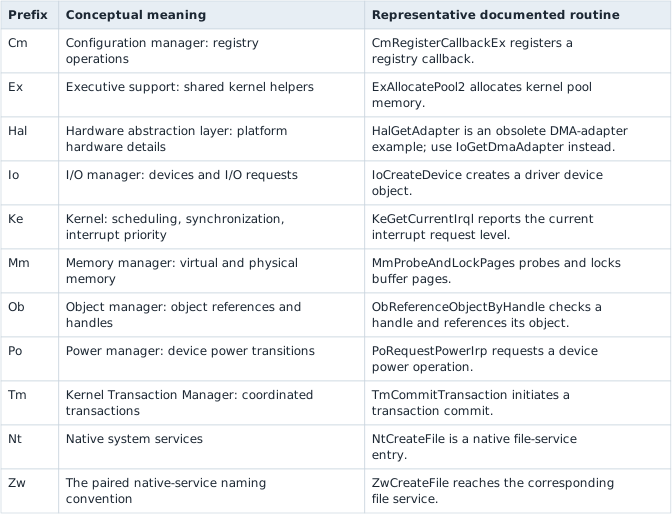
In brief: A prefix identifies a family of routines; it grants no privilege. The processor’s mode, the A P I’s requirements, and the request’s permissions still determine what a caller can do.
Nt and Zw need one extra distinction. For system calls from user mode, their versions behave alike and treat arguments as untrusted user input. From kernel mode, Zw treats parameters as coming from a trusted kernel source; Nt uses the calling thread’s previous mode to decide how to interpret and validate them. This is a calling-context rule, not a way for a user program to gain ring 0. Microsoft’s Nt/Zw explanation describes the distinction.
Older examples need a version check. ExAllocatePool is deprecated; Microsoft’s migration guide replaces it with ExAllocatePool2 for drivers targeting Windows 10 version 2004 or later. HalGetAdapter remains listed for existing drivers, but the documented replacement is IoGetDmaAdapter. An old name in a stack can explain the subsystem without being a good choice for new code.
Section: Why a kernel bug takes the whole machine down.
When user-mode code follows a bad pointer, the processor raises a page fault, the kernel finds that nothing valid lives at that address, and it turns the fault into an access-violation exception for that one process. In the worst case one process ends; the kernel is the safety net under every user-mode program.
Nothing sits beneath the kernel in the same way. Kernel code and drivers share one address space and one set of data structures, so when a driver follows a bad pointer by mistake, the unexpected fault may strike halfway through an update to one of those structures, with a lock still held. Windows cannot prove which of its records are still sound, so it stops the whole machine on purpose. That stop is a bug check, better known as the blue screen: Windows shows a stop code, writes a crash dump if it can, and restarts. Lesson 12.9 follows that decision step by step, beside the other risks of trusted kernel code. It is also why the book keeps its labs in user mode and inside a virtual machine: a crash in a user-mode lab ends one process, and even a bug check inside a virtual machine stops only that virtual machine.
Section: Why some anti-cheat runs a kernel component.
Anti-cheat software exists to notice when another program interferes with a game. A kernel component lets it use Windows facilities that user-mode code cannot reach. One of them is a handle-operation callback, which runs while another process opens a handle to the game and may remove rights from the request. A tool that asks for read and write rights can receive a handle without them, and its ReadProcessMemory then fails at exactly the rights check described above.
The cost is that such code has the same authority as the rest of the kernel. Its bugs become bug checks on players’ machines, and a vulnerability in it becomes a vulnerability in every machine it is installed on. Lesson 15.3 weighs what that extra visibility buys against those costs. First, the next lessons in this chapter show what driver code actually does and why its interface must be narrow.
References: User mode and kernel mode, process security and access rights, bug check code reference, and ObRegisterCallbacks.