Section: The problem with replacing code.
The pointer path gives us a repeatable way to find data, but it cannot add behavior. Replacing the gold-changing instruction with nop was useful for one quick test, but it could only remove behavior. What if we want to observe values, add a check, or run several instructions and then resume the game?
A code cave is a spare executable area used for extra code. A detour redirects execution there and then returns.
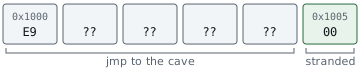
The road-diversion image behind the name is worth taking literally, because every part of it maps onto something you have to get right. You put a sign at one junction sending traffic down a side road that rejoins the main road further along. You have not demolished the main road, so traffic can be restored by removing the sign. The side road must rejoin — a diversion that just stops leaves everyone stranded, which is what a detour with no return jump does. And the sign has to replace a whole junction, not half of one, which is the instruction-boundary problem below.

Section: A detour needs five parts.
A responsible detour has:
hook site — the instructions being replaced;
saved bytes — an exact copy of those original instructions;
cave — memory where the new code can execute;
extra logic — the observation or change;
return address — the first untouched instruction after the hook.
If any one is wrong, the game may crash or behave strangely.
In brief: A detour has five parts: a hook site, saved bytes, a cave, the extra logic, and a return address. Get one wrong and the game may crash.
Section: Instructions are not all the same size.
On x86, one instruction may be 1 byte and another may be 7 bytes. A typical near jump needs 5 bytes. You must replace whole instructions until you have enough room.
The reason is that the C P U, central processing unit, keeps no map of where instructions begin. It starts decoding at whatever address it is handed and reads forward, letting each opcode announce how many bytes it consumes. Start it one byte late and every instruction from that point on is decoded from the wrong position.
Take the six-byte span this lesson hooks:
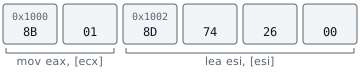
A five-byte jump written over it covers 8B 01 8D 74 26 and strands the final 00. When the cave later returns to hexadecimal 1 0 0 5, the C P U does not see “the leftover tail of a lea.” It sees a fresh byte stream beginning with 00, which starts a completely different instruction that swallows whatever follows as its operands. Execution continues confidently into nonsense, and the crash usually surfaces somewhere unrelated a few instructions later — which is what makes this mistake so hard to diagnose after the fact.
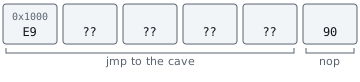
So you round up to the next instruction boundary: cover all six bytes and fill the spare sixth byte with a nop. The return address is the hook address plus the total number of whole bytes replaced.
Alternative: Think of cutting a sentence to paste in a sticker: cut between words, never in the middle of one, or the leftover letters read as nonsense.
Section: Follow the detour before writing a D L L, dynamic link library.
For the pinned Wesnoth 1.14.9 build, the Terrain Description menu reaches a six-byte span at this value: 8B 01 8D 74 26 00. The first two bytes encode mov e a x,[e c x]; the other four encode an alignment lea. A jump needs five bytes, so it must cover both whole instructions and resume at this value, the first untouched byte.
This short x86 sketch puts code beside the flow diagram above. The two instructions near the end replay the behavior removed from the hook site; the final jump lands after all six covered bytes:
Code example. The surrounding prose explains this example; the full lesson contains the exact code.

extra_logic is a placeholder, not a ready-to-install hook. The exact implementation also has to verify the original bytes, encode a reachable relative jump, and restore the patch when disabled.
Lesson 2.10 uses x64dbg to trace that route with breakpoints before adding behavior. Lesson 8.3 then builds the full D L L version: checked gold pointer path, naked x86 cave, relative jump bytes, saved registers and flags, injector commands, F1 toggle, and restoration. The exact code and stack diagram live beside that runnable implementation.
Section: Why assembly is still required.
A detour begins and ends at machine-code boundaries. The surrounding program can:
allocate and own buffers;
calculate and verify addresses;
decode instructions with a library;
build a patch plan;
restore original bytes automatically;
expose a small safe A P I, application programming interface.
The final jump bytes and an in-process hook still require unsafe code and a small amount of assembly. Typed code manages the larger, error-prone lifecycle:
Code example. The surrounding prose explains this example; the full lesson contains the exact code.
Before writing, compare the bytes in memory with original. If they differ, stop. The target may be a different version or another tool may already have changed it.
Narration: Checking the original bytes first turns a game update into a clean refusal, instead of a crash from writing a jump into the middle of different code.
Section: Restore is part of the design.
A patch is not complete until it has a cleanup path. Plan restoration before applying the detour:
store the exact original bytes;
restore them when the feature is disabled;
restore them when the tool exits normally;
make repeated enable/disable operations safe.
This habit will shape the wrappers we build later.
The key distinction is lifecycle code versus boundary code. The manager owns the patch, validates the target, reports failures, and restores state. Assembly describes the few C P U instructions that must run at the exact hijacked boundary.