Imagine a game displaying a green integrity indicator while an inventory item has already changed. A hash proves something about the byte range and moment it covered; a snapshot may be only a copy of the state the game actually uses. Tracing the state transition and the check’s decision tells us whether the indicator describes the authoritative value.
Section: An integrity check is a claim about a boundary.
An integrity check answers a narrow question such as, “Do these bytes equal the expected bytes?” It does not automatically prove that the whole process, file, object, or later operation is unchanged.
Alternative: An integrity check resembles a dated photograph of a marked area: it says nothing about unpictured fields or changes after the picture was taken.
Every integrity check has five boundaries, and a passing result means nothing outside them:
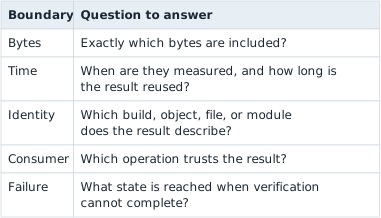
The target invariant for this lesson is:
A sensitive toy operation proceeds only when verification covers the same object, the required fields, and the state used by that operation.
Section: Follow the decision, not only the checksum function.
The important path begins with canonical state and ends at the effect:

A result that is cached, copied to another object, or checked far from the effect adds edges to this path. Each added edge is a place where the result can stop describing the object, and the moment, it was computed for.
Section: A toy integrity record.
This deliberately small record uses a checksum as an accidental-corruption signal. It is not cryptographic authentication:
Code example. The surrounding prose explains this example; the full lesson contains the exact code.
The checksum includes every field used to identify the record and interpret health. The range invariant is checked separately because a matching checksum does not make an impossible value meaningful.
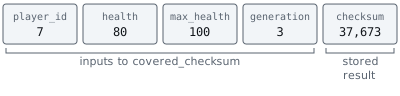
For the record used in the examples below, player 7 with 80 of 100 health at generation 3, the checksum works out like this:
Code example. The surrounding prose explains this example; the full lesson contains the exact code.
rotate_left(7) moves every bit of the 32-bit word seven places toward the high end, and any bit pushed off the top re-enters at the bottom. For a small number nothing reaches the top. 100 is the numeric value shown in binary, seven bits wide because it is less than 2 to the power of 7 equals 128, so after moving seven places its highest bit sits at position 6 + 7 equals 13, far below bit 31. The rotation is then exactly a multiplication by 2 to the power of 7. The same reasoning turns 3.rotate_left(13) into 3 times 2 to the power of 13. The total, 37,673, is far below 2 to the power of 32 (about 4.3 billion), so none of the wrapping operations actually wraps.
Section: Distinguish four failure classes.
Section: Incomplete coverage.
A check covers health but ignores max_health or player_id. The bytes can be internally consistent while describing the wrong entity or an impossible range.
Watch it happen to the record above. Suppose covered_checksum had been written without the max_health term — an easy omission, since the field is rarely the one being updated. For player 7 that shorter sum is 217 + 80 + 24,576 equals 24,873, and 24,873 is what the record stores. Now change max_health from 100 to 60 and recompute nothing:
Predict first
The record stores the shorter checksum, 217 + 80 + 24,576 equals 24,873. Then max_health drops from 100 to 60, and nothing is recomputed.
When verify recomputes the shorter checksum, does it still equal the stored 24,873?
Answer: Yes: it is still 217 + 80 + 24,576 equals 24,873. None of the three terms reads max_health, so the recomputed sum equals the stored one. verify still refuses this record, but only because its second clause finds 80 greater than 60.

The checksum is doing its job correctly. It is reporting that every byte it covers is unchanged, and that is true. The record is still impossible, because the damage was done to a field the check never looked at.
The complete covered_checksum catches the same edit. With max_health equals 60 its third term becomes 60 times 128 equals 7,680, so the sum becomes 217 + 80 + 7,680 + 24,576 equals 32,553, which no longer equals the stored 37,673.
This is why verify has two clauses rather than one. The checksum answers “did the covered bytes change?” and the range test answers “is this record possible?”, and neither question implies the other. A record can pass one and fail the other in both directions, so a check that asks only the first will accept states the game’s own rules forbid.
Section: Wrong source of truth.
The code verifies a display cache, then applies an operation to the canonical simulation object. The check and effect refer to different state.
Section: Stale decision.
The program verifies generation 17, the object changes to generation 18, and a later operation trusts the old true. This is a time-of-check/time-of-use problem.
Narration: A saved successful result can survive an object update. Tagging it with the checked generation makes that stale approval distinguishable from a current one.

The result was correct when it was computed. It went stale because nothing tied it to the generation it described. A consumer that compares the result’s generation with the record’s current generation refuses it at the last step.
Section: Ambiguous failure.
A read error, unsupported build, and genuine mismatch all become false or, worse, silently become “valid.” Use explicit results:
Code example. The surrounding prose explains this example; the full lesson contains the exact code.
These variants are useful telemetry and make tests state exactly which promise failed.
Section: Keep verification beside the effect.
A guarded update can consume the same mutable object it verifies:
Code example. The code’s comments explain: The checked object is also the object changed below.
This local function is easy to reason about because the check and effect share one exclusive borrow. Across process or thread boundaries, use versioned snapshots, expected-byte comparisons, or a command sent to the owner of the state; a remote read followed by a remote write is not atomic.
In brief: Keep verification and the guarded update attached to the same current state; a separate remote read and write cannot promise atomicity.
Section: Test the relation, not one handpicked example.
Useful regression properties include:
changing any covered field without updating the checksum is rejected;
changing an uncovered display-only field does not affect verification;
health greater than max_health is rejected even with a recomputed checksum;
a stale generation is refused at the consuming boundary;
read failure produces Unreadable, never “valid”;
every refusal emits a bounded reason code and no state change.
For the small record above, iterate over each covered field and flip one bit. That mutation test proves the test suite notices missing coverage.
Section: Glossary terms introduced here.
Integrity: confidence that state still satisfies its required relation.
Coverage: the exact data and conditions examined by a check.
Canonical state: the state the game actually uses to decide an effect.
Freshness: whether a check result still describes the state being consumed.
TOCTOU: a gap in which state changes between checking and using it.
Postcondition: a property that must hold after an operation completes.
An integrity result describes only the bytes it covered, the identity and time of that check, and the consumer that acts on it. A missing field or stale result breaks the link to the guarded effect. The mutation test above exposes missing coverage; the repair puts verification where the current state becomes an effect.